
A $45 Million Sports Complex, and the Money No One Can Verify
A village of a few thousand people is building a professional basketball practice facility on a private partner’s promise — one its own treasurer can’t confirm, and one it told bond investors was worth half as much.
Bedford Park, Illinois is building the roughly $45.8 million Phase 2 of its Wintrust Sports Complex, including a practice facility for the WNBA’s Chicago Sky. The Village agreed to spend its own $32.9 million first. Its records show the Village paying. They do not show the Sky paying much of anything beyond an initial $1.5 million — and when the Village’s own treasurer asked the bank for a statement of the account holding that money, she was told she couldn’t have one without the Chicago Sky’s permission.
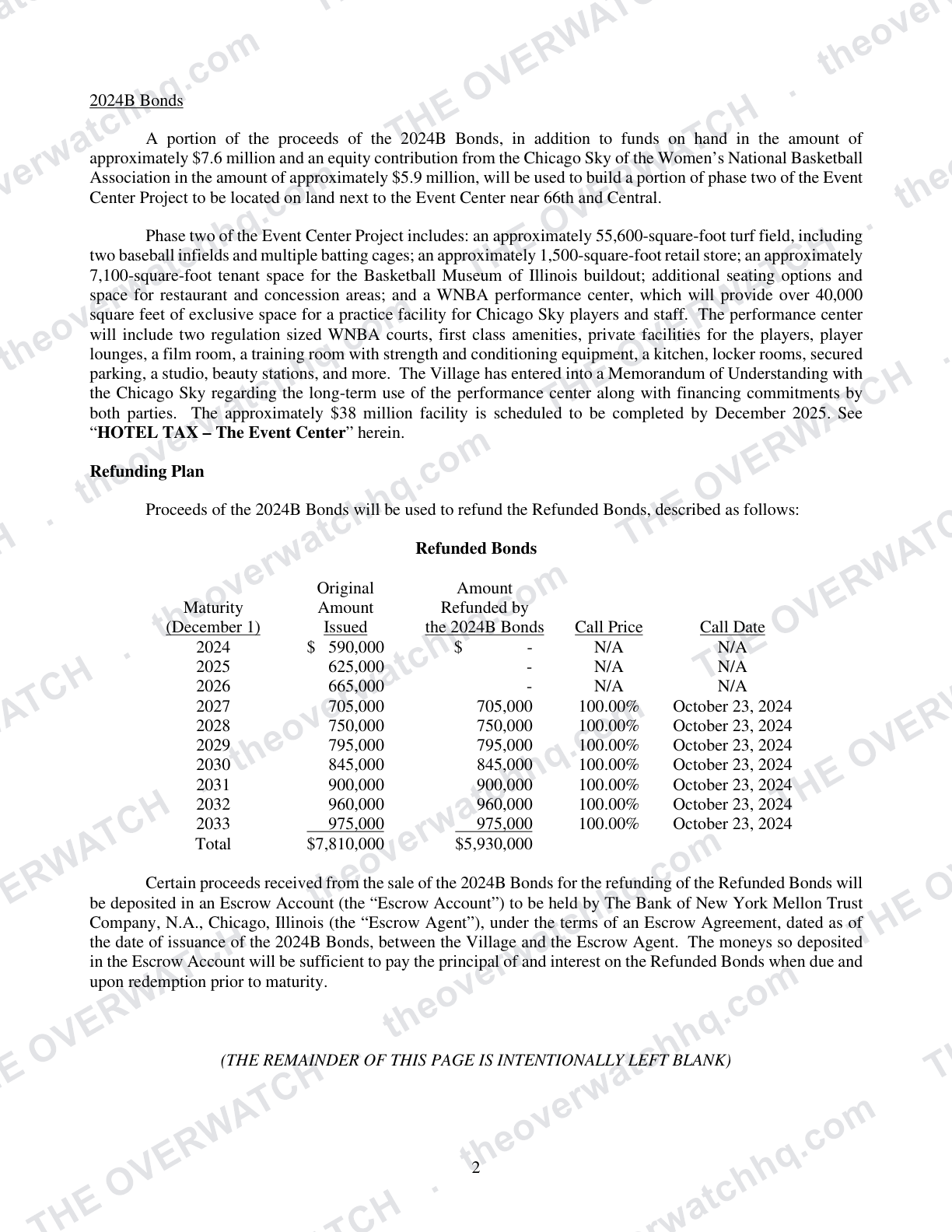
Meanwhile, the bond investors who helped finance the project were told, in September 2024, that the Sky would contribute about $5.9 million toward a $38 million building finished by December 2025. The real figures turned out to be $12.88 million, $45.8 million, and a November 2026 opening.
“Bingo.”
On January 13, 2026, the Village of Bedford Park’s attorney forwarded an email to the mayor and the village’s finance staff. A trust officer at Wintrust Private Trust had just confirmed that the Chicago Sky’s initial escrow money — $1 million one day, $500,000 the next — had landed in the account. The attorney’s entire message was one word:
“Bingo.”— Village Attorney Lawrence Gryczewski, forwarding the funding confirmation to Village officials, Jan. 13, 2026
That $1.5 million is the only Chicago Sky money this reporter has been able to document anywhere in the public record. And even it exists only as an email — a bank employee writing that a wire arrived. There is no bank statement. As it turns out, the Village can’t get one.

The account the Village can’t see
In late March 2026, Village Treasurer Sandra L. Sheehan, a CPA, needed a year-end statement of the escrow account for the Village’s annual audit. She emailed the bank. The answer she got back is the heart of this story:
“I can only send the requested statement to an authorized person on the account unless approved by them. The authorized signers are: Michael Alter, Stephanie Hedrick and Adam Fox.”— Rochelle Martin, VP & Trust Officer, Wintrust Private Trust Co., to the Village Treasurer, March 31, 2026
All three authorized signers are Chicago Sky principals: its owner (Michael Alter), its chief financial officer (Stephanie Hedrick), and its chief executive (Adam Fox). The mayor was later added as a signer, and the bank advised that any disbursement requires a joint, signed direction from both sides plus a call-back.
Stop and consider what that means. This escrow is supposed to hold the private partner’s contribution to a public building. Yet the public body that owns the building — whose own treasurer is trying to close an audit — cannot read a statement of the account without the private partner’s consent.
Here is the logic that should trouble any taxpayer: if that escrow were truly held for the benefit of the Village of Bedford Park, the Village would not need the Chicago Sky’s permission to see it. A beneficiary who cannot read the account without the counterparty’s sign-off does not control the account — and cannot independently prove the money it was promised is actually there.

Emails are not a bank statement
It is worth being precise about evidence, because the Village’s position seems to be that an attorney’s “Bingo” and a bank officer’s “I received the money” settle the question. They do not.
An email describing a deposit is a representation of what happened in an account. The primary evidence of what an account actually holds — and of what has moved through it since — is the account’s own statement. This is not a matter of opinion. The best-evidence rule holds that to prove the contents of a record, you produce the record, not a description of it (Ill. R. Evid. 1002). A bank statement is a classic business record (Ill. R. Evid. 803(6)), admitted through a custodian’s certification (Ill. R. Evid. 902(11)); a casual email is neither. Independent auditors themselves confirm cash by direct bank statements, not by a counterparty’s say-so — which is exactly why the Village’s treasurer asked for one, and exactly what she couldn’t get.
The records request that came back empty
In April 2026, this reporter filed an Illinois Freedom of Information Act request for the escrow’s account statements, deposit records, and disbursement records. The Village’s response produced the escrow agreements and the emails — and, for the records that would actually prove the money, a single boilerplate line: “Attached are records in our possession based on your request.” No statement. No deposit ledger. No disbursement record.
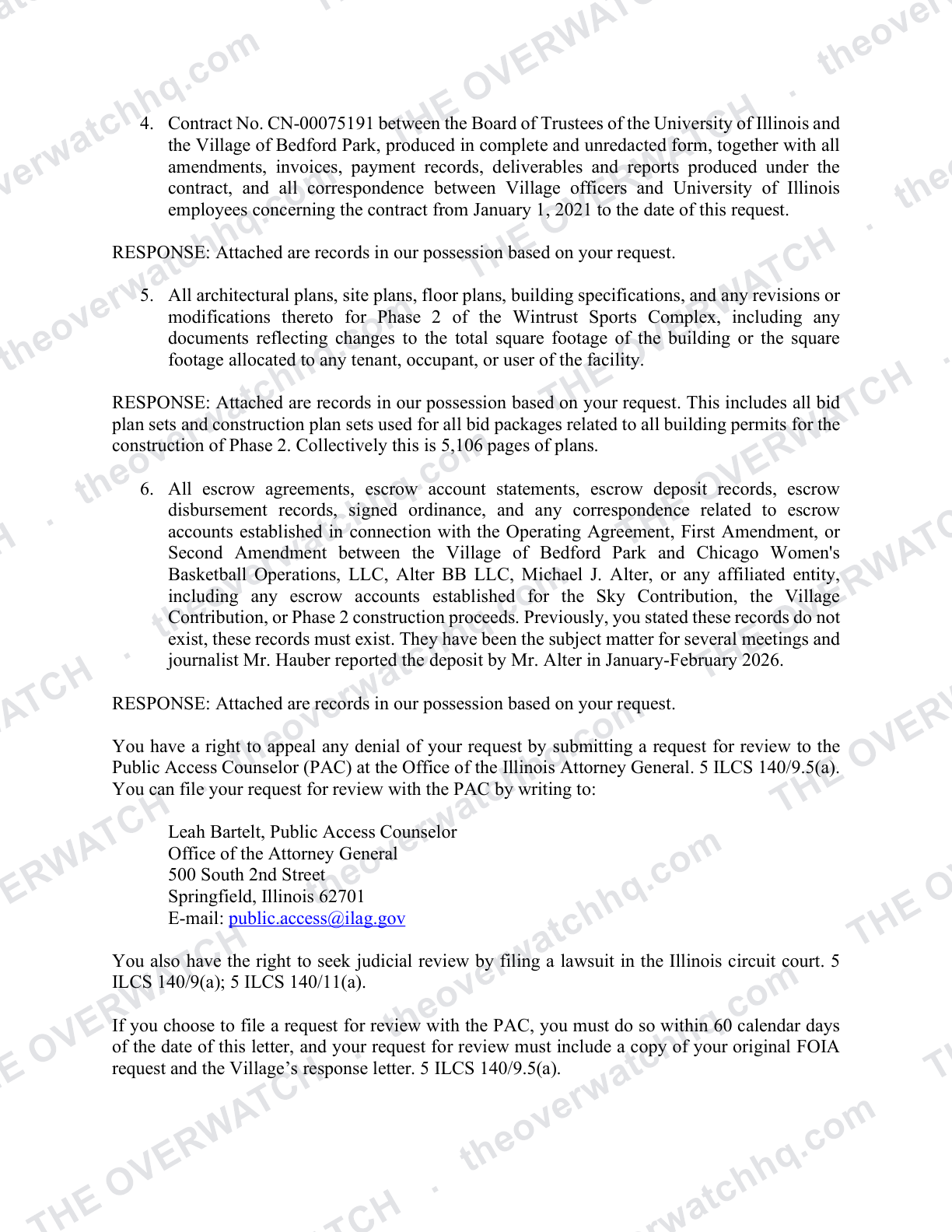
The reason the Village can’t produce those records appears to be the same reason its treasurer couldn’t get a statement: the account is controlled by the Chicago Sky’s signers, not the Village. Which raises an obvious question — if the money moved, where is it recorded on the Village’s own books? Under Illinois municipal-finance law, a village must authorize its expenditures and keep a general ledger and cash journals; a receipt or a draw of this size would leave a trail in the minutes and the ledger. So far, that trail is silent. A follow-up FOIA for the general ledger is pending.
Three documents, three different numbers
Here is where the story widens from a bookkeeping problem into a disclosure problem. To help pay for Phase 2, the Village sold municipal bonds in September 2024. The disclosure document given to investors — its Official Statement — describes the Chicago Sky’s stake in the project. And the number it gives does not match the Village’s own contract.
The Official Statement told bond investors the Sky’s “equity contribution” was approximately $5.9 million. The operating agreement the Village executed in February 2026 puts the Sky’s contribution at roughly $12.88 million. The escrow emails show $1.5 million. Same contribution, three documents, three numbers — and only the smallest one has any evidence behind it.
The Chicago Sky’s contribution, by document
Where the bond money really went
The bonds themselves are worth a close look. In September 2024 the Village issued $30.64 million in Hotel/Motel Tax Revenue Bonds — debt repaid not from property taxes but solely from the village’s 10.5% hotel room tax. The whole enterprise is a bet on hotel stays.
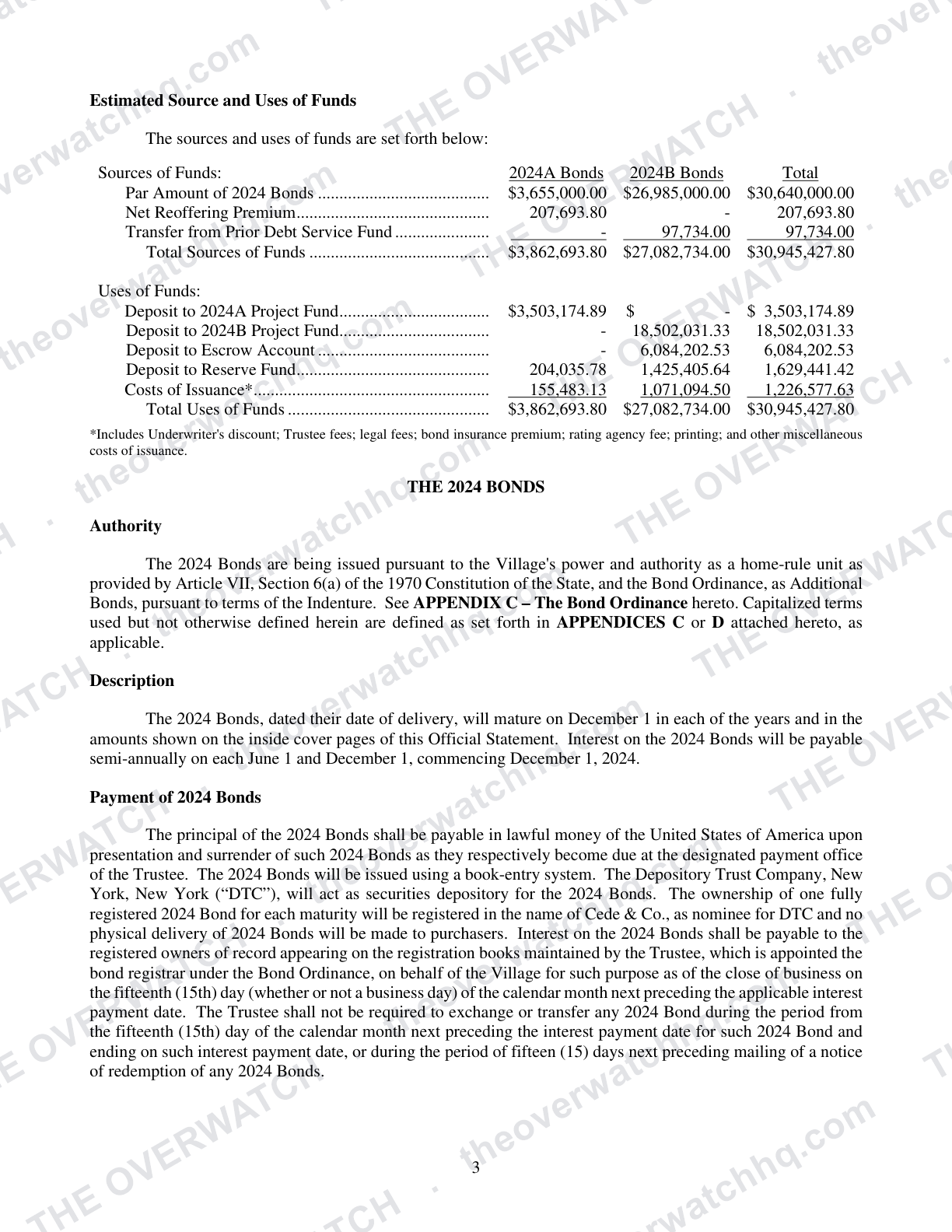
And despite being sold as event-center financing, a large share of the money was earmarked for other things. The Official Statement’s own “Sources and Uses” table shows that of the $27 million Series 2024B issue, only $18.5 million went to the actual build. More than $6 million went to refinance old 2013 bonds — the debt that had originally bought the land — with the rest to reserves and issuance fees. A separate $3.66 million slice of the deal went entirely to street and TIF work, not the event center at all.
Where the $27 million Series 2024B bond went
What investors were told, and what happened
The same Official Statement described “the approximately $38 million facility” as “scheduled to be completed by December 2025.” Neither turned out to be true. The guaranteed maximum price the Village executed in February 2026 was $45.77 million, and the opening is now set for November 2026 — a year late.
Facility cost: told to investors vs. executed contract
An Official Statement is the document bond investors rely on to decide whether to lend. Material misstatements or omissions in municipal-bond disclosures fall under federal securities law and the SEC’s continuing-disclosure rule. Over the past five years, the Village’s event filings on the municipal market’s EMMA system reflect only routine rating changes and a bond-insurer merger — no notice of the roughly 20% cost increase, the year-long delay, or the shifting Sky contribution. Whether any of that crossed the line into a reportable event is a question for securities counsel. The gap between what the document said and what happened is simply a fact.
Why it matters
In this reporter’s assessment, the pattern here is municipal waste and opacity, and it follows a recognizable shape:
- A public body fronts tens of millions for a building whose private beneficiary’s funding it cannot independently verify.
- The one record that would settle the question — a bank statement — is controlled by that private beneficiary.
- The public’s records requests come back with agreements and emails, never the ledger.
- Large batches of construction payouts are approved by “omnibus” votes with no figures read aloud.
- And the numbers told to bond investors do not match the numbers in the Village’s own contracts.
A ribbon-cutting is days away. The building will open. The unanswered question is older and simpler than the building: produce the bank statement.
The records behind this story
- FOIA request (April 21, 2026) and the Village’s response letter (May 5, 2026)
- Wintrust Private Trust escrow correspondence (Jan–Apr 2026), including the funding and statement-access emails
- Executed Guaranteed Maximum Price and Second Amendment to the Operating Agreement (Feb 19, 2026)
- Final Official Statement for the 2024A/2024B Hotel/Motel Tax Revenue Bonds (Sept 4, 2024), filed on the MSRB’s EMMA system
- 2026 Village Board meeting minutes and agendas
- Pending: Public Access Counselor request for review (2026 PAC No. 94095); a follow-up FOIA for the Village general ledger
About this report. This article is based entirely on public records: the Village of Bedford Park’s own FOIA productions, its executed agreements, its municipal-bond Official Statement filed with the MSRB, and its published Board minutes and agendas. Quotations are reproduced from those records. Statements of fact are drawn from those documents; characterizations such as “municipal waste” are the author’s opinion based on the disclosed facts. This report raises questions of public accountability and does not allege that any individual has committed a crime.
© 2026 The Overwatch. The Bedford Park Files.